















Accurate, fast and secure email verification service
Verify email lists instantly — reduce bounces, clean data, and protect your sender reputation.
Ask AI about Email Awesome





© 2026 Email Awesome. All rights reserved.

The average cold email open rate fell to 27.7% in 2026. The top 10% of campaigns hit 58% or higher. Gong analyzed 85 million cold emails and found that subject lines with 1 to 4 words, all lowercase, and zero selling language consistently reach 58%+ open rates, more than double the industry average.
The gap between 27% and 58% is not better templates. It is not more A/B testing. It is format, personalization, and the point that almost no subject line guide mentions: deliverability. The best cold email subject line in the world is already in the spam folder if your bounce rate is above 2%. This article covers the cold outreach subject line formulas that work for B2B email, the data behind them, and the prerequisite that makes subject line optimization meaningful.
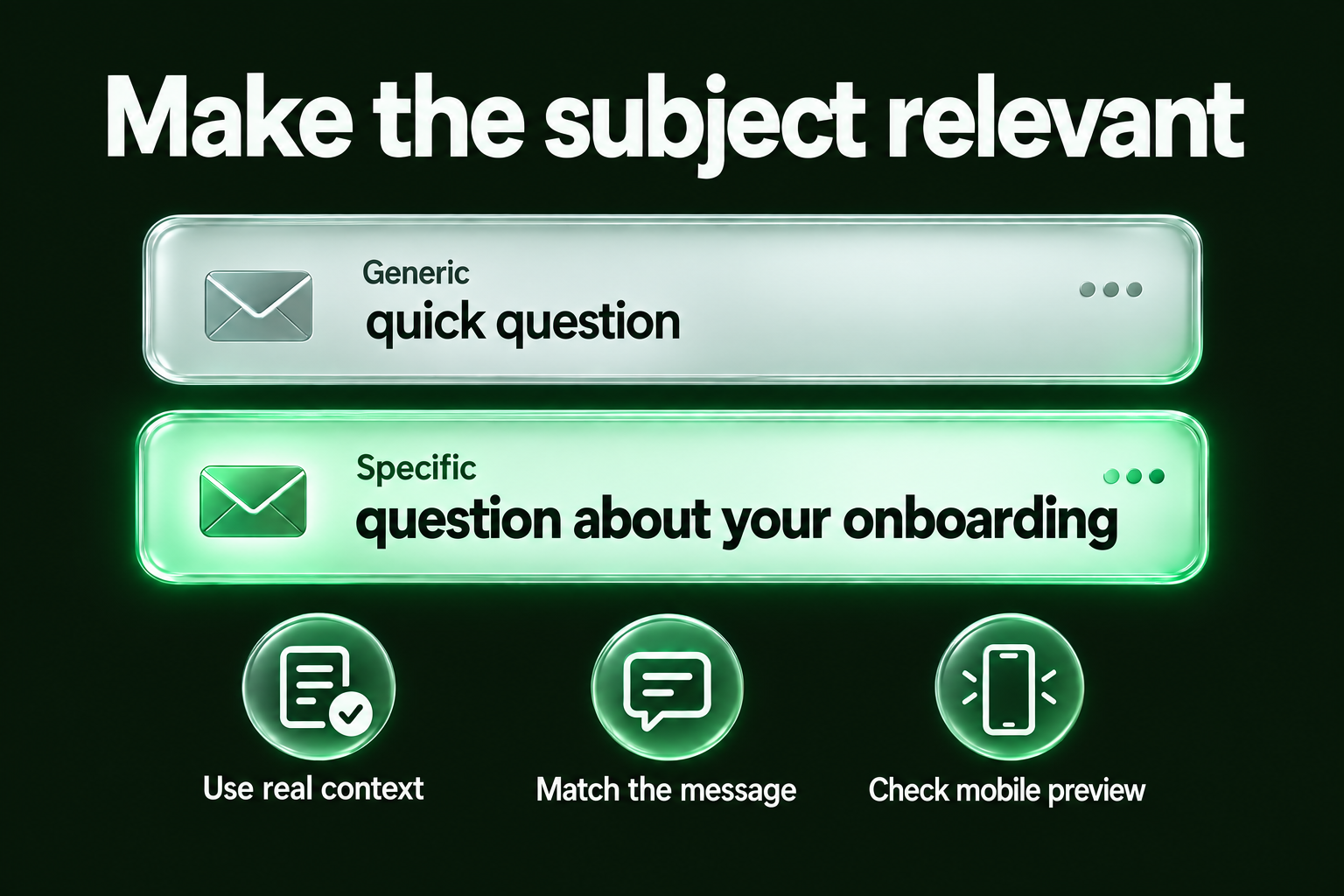
The examples compare a generic subject with one that names a concrete topic. Use the specific version only when onboarding is genuinely relevant to the recipient and is addressed in the message. Keep the subject truthful, preview it on mobile, and evaluate it with your own audience; wording alone does not guarantee an open or a reply.
Five characteristics separate cold email subject lines that get opened from ones that get deleted. Each is measurable, each is tied to real open rate data, and each addresses a different dimension of personalization and format.
Mobile devices truncate subject lines after 35–40 characters. A recipient who cannot read the full subject line on their phone is significantly less likely to open the email. Subject lines of 21–40 characters with company-specific personalization predict 60%+ open rates in 74% of campaigns analyzed by ColdMailOpenRate's study of 5 million emails. Snovio's 2026 research confirms the sweet spot at 36–50 characters for the highest response rates.
Count characters before you send. "Quick question about your Apollo exports" is 41 characters, one over. "Apollo exports question" is 23. The shorter version performs better.
Subject lines written in all lowercase read like internal emails from a colleague. They do not read like campaigns. Gong's analysis of 85 million cold emails found that subject lines with 1–4 words in all lowercase and zero selling language hit 58%+ open rates consistently.
The internal camouflage test: could this subject line have come from someone inside their company? "quick question about your outreach" passes. "Exclusive Offer, Limited Time Only" does not. Capitalization is a campaign signal that recipients have learned to recognize and dismiss.
The subject line has one job: earn the open. Not convince. Not pitch. Not describe the offer.
Words and phrases that trigger spam filters and recipient skepticism: "free", "act now", "limited time", "exclusive", "check this out", "exciting opportunity". These are not just spam filter triggers. They are signals to the recipient that this is a mass outreach email, which is exactly the opposite of the impression a good cold email needs to make.
Personalized subject lines using the recipient's name and company name achieve 22% higher open rates than generic ones, according to Backlinko's email outreach study. The highest-performing personalization goes beyond first name. It references the specific company in a contextually relevant way.
"Quick question" is generic. "Quick question about [Company]'s outreach stack" is specific. "Quick question about your ZoomInfo export from last week" is specific and contextual. The more specific the reference, the stronger the signal that this is not a blast.
Questions trigger a psychological need to find the answer. Knowledge gaps make recipients curious enough to click. The most effective cold email subject lines reference something the recipient is already thinking about, not a pain you want them to have, but one they demonstrably do have.
"Is your outreach domain flagged?" works for SDRs with deliverability problems. "What happens to your domain at 4% bounce?" works for the same ICP. Both reference a real, specific concern, not a category of concern.
Each formula below includes the structure, three real examples, and guidance on when to use it. The goal is not to copy-paste. It is to understand the pattern so you can adapt it to your ICP.
| Formula | Structure | Examples | Best Open Rate Context | When to Use |
|---|---|---|---|---|
| 1. Trigger Event | [Specific thing that just happened at their company] |
"Saw you're hiring 3 SDRs in Chicago" "Noticed the Series B announcement" "Your post on cold email deliverability" |
Highest — with research | Small, segmented lists where per-contact research is feasible. Use trigger event tools (Clay, Apollo alerts) to scale. |
| 2. Named Problem | [Their specific, recognizable pain] — stated plainly |
"Apollo exports with 4% bounce rates" "Outreach domains getting flagged" "ZoomInfo data decaying mid-sequence" |
High — technical ICPs | ICPs with a specific, technical, universally recognized pain. Generic pains do not work in this formula. |
| 3. Ultra-Short | [1–3 words: curiosity gap or direct reference] |
"quick question" "your bounce rate" "outreach infrastructure" |
58%+ — per Gong (85M emails) | Follow-ups and re-engagement. Requires highly personalized body copy. Weakest as a cold first touch without personalization. |
| 4. Social Proof | How [specific peer company] [achieved specific result] |
"How [Competitor] cut bounce rates before Q2" "What [similar SaaS] changed about their outreach" "Why [peer] stopped using Apollo unverified" |
High — enterprise ICPs | When you have real, specific peer social proof. Never use fabricated or vague social proof — credibility is destroyed on first read. |
| 5. Specific Number | [Precise number] + [specific result or context] |
"15% more connection rates after this" "340 invalid emails in your last export" "Under 1% bounce rate on 20K contacts" |
High — data-driven buyers | When you have real, defensible data. The number must hold up in the first paragraph of the email body. |
| 6. Direct Question | [The specific question they're probably already asking] |
"Is your outreach domain flagged?" "What happens to your domain at 4% bounce?" "Who handles list hygiene before your sends?" |
High — active frustration | When the ICP is in an active moment of frustration or decision. References a specific metric or process they already recognize. |
Structure: [Specific observable thing that just happened at their company]
Examples:
Why it works: The trigger event proves you did research on this specific person. It signals that this is not a mass email. It creates immediate relevance: you are referencing something they are actively thinking about.
When to use: Smaller, tightly segmented lists where research is feasible. This formula does not scale without trigger event data. Tools like Clay, Apollo, or LinkedIn alerts can surface trigger events automatically for larger lists.
Structure: [Their specific, recognizable pain] stated plainly, without explanation
Examples:
Why it works: The named problem requires no explanation because the recipient already understands it. If they recognize the problem, they open to find the solution. If they do not recognize the problem, the email was sent to the wrong person, which is valuable signal in itself.
When to use: ICPs where the pain is technical, specific, and universally recognized within the segment. Generic pains ("increase revenue", "close more deals") do not work in this formula. Specific operational pains do.
Structure: [One to three words that create a curiosity gap or direct reference]
Examples:
Why it works: Ultra-short subject lines have the highest open rates in Gong's data. They feel personal and direct, like a message from someone the recipient already knows. The entire weight of the email is on the body copy.
When to use: Follow-up emails and re-engagement sequences where the initial context has already been established. Using ultra-short subjects as first touches works best when the email body is highly personalized. A generic three-word subject on a generic email body destroys credibility immediately.
Keep exploring: See the Cold Sales workflow for the relevant Email Awesome setup, then read Cold Email Deliverability Best Practices for the practical foundation.
Structure: How [specific peer company] [achieved specific result]
Examples:
Why it works: Peer validation is the most powerful form of proof in B2B. A result from a comparable company removes the "this won't work for us" objection before the email body has a chance to make the case. The company name in the subject line increases open rate on its own.
When to use: When you have real, specific social proof from comparable companies. Never use fabricated or vague social proof. The recipient will notice in the first sentence of the email body, and the damage to credibility is permanent.
Structure: [Precise number] + [specific result or context]
Examples:
Why it works: Specific numbers imply measurement, proof, and real-world results. "Save time on reporting" sounds like marketing. "Save 5 hours per week on reporting" sounds like data. Specificity builds credibility in a way that vague claims cannot.
When to use: When you have real data: your own benchmark, a client result, or a relevant industry statistic. The number must be defensible in the first paragraph of the email body.
Structure: [The specific question they are probably already asking themselves]
Examples:
Why it works: The direct question meets the recipient where they already are mentally. It does not introduce a new problem. It surfaces one they already have. The best versions reference a specific metric or process that only someone inside the ICP would recognize.
When to use: When the ICP is in an active moment of frustration or decision. An SDR whose open rates just dropped is a perfect target for "Is your outreach domain flagged?" Someone mid-sequence planning is the right target for "Who handles list hygiene before your sends?"
Certain words reliably trigger spam filters and recipient skepticism simultaneously. The overlap is not accidental. Inbox providers learned these patterns from human behavior.
Avoid: "free", "act now", "limited time offer", "exclusive", "no obligation", "risk-free", "click here", "you won't believe", "earn money", "work from home". None of these belong in a cold email subject line. Not because of the spam filter. Because they tell the recipient this is a broadcast, not a conversation.
"Re: our conversation" when there was no conversation. "Fwd: thought you'd find this interesting" when nothing was forwarded. Recipients recognize these patterns immediately. They have seen them thousands of times. Using them triggers the exact opposite of the intended trust signal.
"You won't believe this", "Have you seen this?", "Important update", "Quick question" with no context. These patterns worked in 2019. In 2026, they signal mass outreach to every recipient who has been on a cold email list for more than six months, which is most of your ICP.
Pro Tip: "The cold email subject lines with the highest open rates look like they were written for one person. The ones with the lowest look like they were written for a list. Recipients cannot see your segmentation data, but they feel the difference immediately."
If you want to see how these subject line formulas work in the context of a complete cold email, the cold email examples guide covers five full emails with copy and analysis.
Open rates above 40% almost always trace back to clean deliverability infrastructure, not just great cold email subject lines. A subject line that lands in spam has a 0% open rate regardless of how well it was written. Before diagnosing a subject line problem, run this four-point check.
Why are cold emails not getting opened despite good subject lines? If your open rate is below 25% on a domain that was previously performing well, deliverability degradation is the likely cause, not the subject line. A bounce rate above 2% damages sender reputation with Gmail and Microsoft, reducing inbox placement for every email you send. A flagged domain routes to spam before any recipient ever sees the subject line.
The four-point deliverability check before adjusting subject lines:
1. Bounce rate below 2%? If not, the problem is list quality, not subject lines. A bounce rate above 2% triggers enforcement from Gmail. Above 3%, domain reputation is at risk. Above 5%, stop sending immediately and clean your list. Running email verification before each sequence removes the invalid addresses that generate hard bounces before they count against your reputation.
2. SPF, DKIM, and DMARC passing? Before diagnosing a subject line problem, verify that SPF, DKIM, and DMARC are correctly configured. An unauthenticated domain routes to spam regardless of subject line quality.
3. Spam complaint rate below 0.1%? Gmail's enforced threshold is 0.1%, not the commonly cited 0.3%. At scale, 1–2 complaints per 1,000 emails can trigger filtering. Monitor continuously in Google Postmaster Tools.
4. Open rate dropped suddenly on a healthy domain? Do not change your subject lines. Check Google Postmaster Tools for domain reputation changes first. A sudden drop almost always indicates deliverability degradation. Fixing the subject line will not solve it.
The Apple MPP distortion: Most outreach platforms report open rates inflated by 5 to 10 percentage points because Apple Mail Privacy Protection pre-loads tracking pixels. An open rate of 35% in your dashboard may be a real open rate of 25 to 28%. This means that "optimizing cold email subject lines" sometimes addresses a problem that does not exist. The emails are reaching the inbox, the subjects are being read, but the tracking data is inflated.
Open rates above 40% almost always trace back to clean deliverability infrastructure, not just great subject lines. A bounce rate above 2% damages domain reputation with Gmail and Microsoft, and a flagged domain routes emails to spam before any subject line has a chance to be read. Optimizing subject lines on a domain with a 4% bounce rate is the most common mistake in cold email: solving the wrong problem first.
EmailAwesome users who verify their outreach lists before every send maintain bounce rates below 1%, the baseline that makes subject line optimization meaningful. The top 10% of cold email campaigns achieve reply rates above 10.7% not because they have better cold email subject lines than average, but because their emails actually reach the inbox. List quality is the prerequisite that most subject line guides never mention.
If your bounce rate is above 2%, your subject line is not the problem. Verify Your List Free →
The six subject line formulas in this article work. The reply rate data backs the infrastructure argument. The Gong data, the Snovio benchmarks, the Backlinko personalization study are real, and the patterns they point to are consistent. A three-word lowercase subject line referencing a specific trigger event can hit 60%+ open rate on a clean list with proper authentication.
On a list with 4% bounce rate? That same subject line goes straight to spam. Email deliverability is not a secondary concern for cold email. It is the primary one. Email deliverability comes before copy. The reply rate data is clear: below 1% almost always means an infrastructure problem, not a subject line problem.
The sequence that works: verify your list, confirm authentication is correct, then write the subject line. Not the other way.
EmailAwesome processes lists of up to 20,000 contacts in under 10 minutes. Unknown results are never charged.
Check the most Frequently Asked Questions
What makes a good cold email subject line in 2026?
How long should a cold email subject line be?
Does personalization in subject lines improve open rates?
What subject lines should I avoid in cold email?
Why are my cold emails going to spam despite good subject lines?
Accurate, fast and secure email verification service
Verify email lists instantly — reduce bounces, clean data, and protect your sender reputation.
Ask AI about Email Awesome