







Accurate, fast and secure email verification service
Verify email lists instantly — reduce bounces, clean data, and protect your sender reputation.
Ask AI about Email Awesome





© 2026 Email Awesome. All rights reserved.

The average B2B cold email reply rate in 2026 is 3.43%. The top 10% of campaigns hit 10.7% or higher. That gap is more than triple the average. It doesn't come from better subject lines or smarter frameworks. It comes from list quality and infrastructure. The best cold email examples b2b teams use won't generate replies if 7–8% of the addresses on your list are going to bounce before anyone reads them. Most cold email frameworks start at step one: write a great subject line. This one starts at step zero. It's the step every cold email examples guide skips.
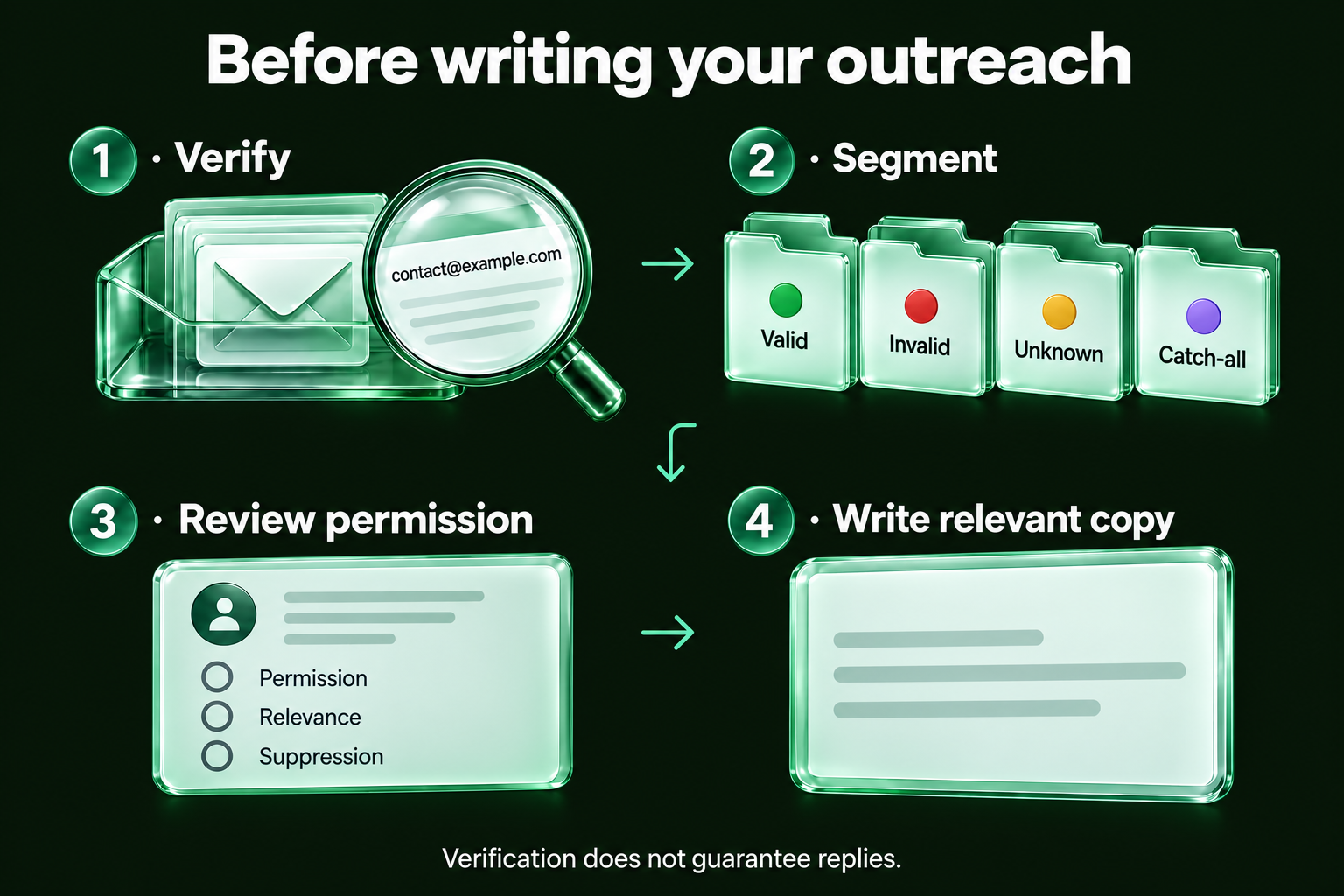
Verify addresses, segment them by the returned result, review permission and relevance, then write the message. Keep Valid, Invalid, Unknown, and Catch-all separate. Passing available checks does not establish consent, guarantee inbox placement, or predict a reply.
Every cold email examples guide assumes your list is clean. It isn't.
B2B contact data from Apollo, ZoomInfo, or LinkedIn exports decays at 20 to 30% annually. People change jobs, companies get acquired, domains expire. A list of 1,000 contacts built six months ago without re-verification already carries 100–150 addresses that will bounce hard. Each one is a reputation event your domain absorbs silently, until Gmail or Microsoft flags you.
Your sending domain is the most fragile asset in your cold outreach stack. Google permanently rejects emails from domains whose bounce rate crosses 2% as of November 2025. Microsoft enforces the same threshold with immediate 550 5.7.515 rejections since May 2025. These thresholds apply to your entire domain, not just the campaign that triggered them.
An SDR running a 2,000-contact sequence from Apollo ran a pre-send verification and found 340 invalid addresses (17%). That's not unusual for a list built from third-party sources without recent cleanup. Without verification, that campaign would have crossed the 2% bounce threshold before the sequence hit email three, damaging the domain for every email that followed, including transactional ones.
After removing the invalid addresses and re-running the sequence to the verified list, the domain stayed clean. Reply rates held. Connection rates improved. That's not a copy win. That's an infrastructure win.
The process takes less time than writing your first cold email example. Upload your CSV, run verification, and segment by result:
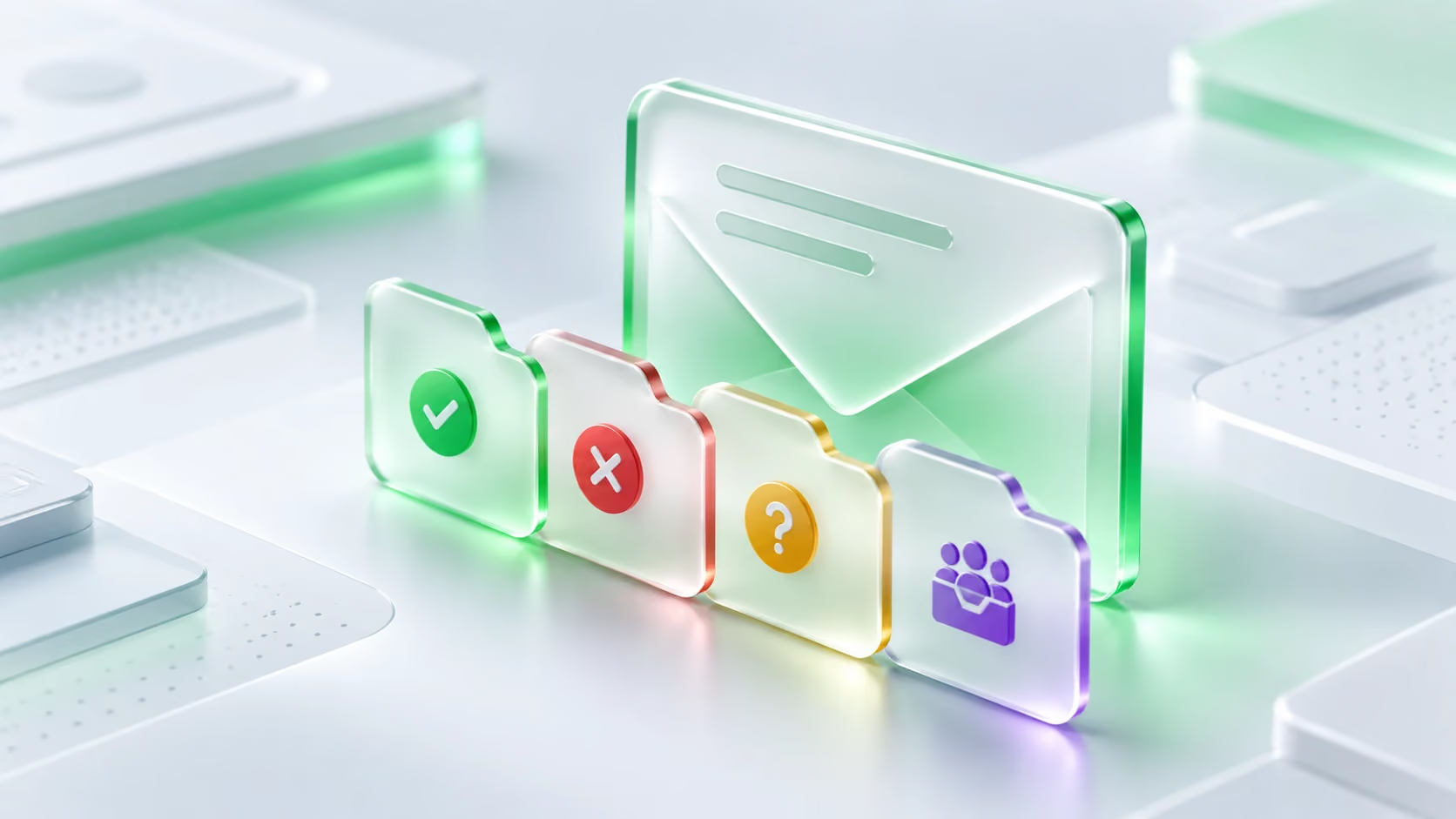
Valid: the available checks passed; still review permission and relevance. Invalid: a clear verification issue was found; remove the address from the sending segment. Unknown: the result is inconclusive; review or recheck it separately. Catch-all: the specific mailbox is unconfirmed; keep it in a separate segment for review.
Email verification runs this process without exposing your sender domain during the SMTP handshake — protecting your sender reputation at every step. It's the fastest way to make your cold email examples actually reach the inbox.
Customer Result: "Since cleaning our outreach lists with EmailAwesome before every send, connection rates went up 15%. The list is smaller, but every address on it is one that can actually receive our message." - Samuel Jones, SDR Manager
Hard bounces from contacts at companies that have recently changed email providers (common in Apollo and ZoomInfo exports) are caught at the MX record lookup layer before any SMTP connection is attempted.
Verify your list before your next sequence. Verify Your List Free →
A strong B2B cold email, and every good cold email example, has five parts. Not a hook, a pitch, and a CTA. Five specific components that work together to move a stranger from cold to curious.
| Part | What It Does | Example Line | Why It Works |
|---|---|---|---|
| 1. Context Line | Proves research. References a specific trigger event about the prospect. | "Noticed you're hiring 3 SDRs in Chicago — usually means outbound is scaling." | Immediately differentiates from mass-blast templates. Signals you understand their situation. |
| 2. Problem-Solution | One sentence on their pain. One sentence on your fix. No features, no company history. | "Most outbound teams hit a deliverability wall before a pipeline problem. We fix list quality first." | Prospect should think: "That's us." If they don't recognize the pain, wrong ICP. |
| 3. Cost of Inaction | Optional question that makes the prospect imagine not acting. Creates urgency without pressure. | "How much pipeline is your team losing to emails that never reach the inbox?" | Prioritizes your email against 50 others competing for attention. Works best in B2B. |
| 4. Social Proof | One comparable company. One specific result. Never generic. | "[Similar company] verified their list before Q2 outreach and saw connection rates jump 15%." | Specificity is credibility. A peer result de-risks the decision for the prospect. |
| 5. Soft CTA | Ask for a reply, not a meeting. Minimize friction on the first touch. | "Does this resonate?" or "Worth a quick conversation?" | Goal of email 1 is a reply. The meeting comes from the reply. Low friction = higher reply rate. |
The context line is not a compliment. "I love what you're doing at [Company]" is not a context line. It's filler a prospect can smell from the subject. A real context line references something specific: a funding round, a job posting pattern, a piece of content they published, a competitor they just lost to.
Example: "Noticed you're hiring three SDRs in Chicago. Usually means outbound is being scaled."
That one sentence does two things: it proves you did research, and it signals you understand their situation without stating it explicitly.
One sentence on the pain. One sentence on the solution. No product features, no company background, no "we help companies like yours."
Example: "Most teams scaling outbound hit a deliverability wall before they hit a pipeline problem. We fix the list quality layer before the first send."
The prospect should finish reading this and think: "That's our situation." If they don't recognize the pain, the email was sent to the wrong person.
Optional but powerful. A single question that makes the prospect imagine the consequence of doing nothing.
Example: "How much pipeline is your team losing to emails that never reach the inbox?"
This isn't manipulation. It's prioritization. The prospect has fifty things competing for their attention. A cost-of-inaction question makes this one feel urgent without false urgency.
One company. One result. One sentence. Specificity is credibility.
Example: "[Company in their space] verified their outreach list before their last sequence and saw connection rates jump 15%."
Generic testimonials ("we've helped hundreds of companies") don't move B2B buyers. A result from a peer at a comparable company does.
Ask for a reply, not a meeting. "Book a 30-minute call" asks a stranger to surrender calendar control to someone they've never met. That's a big ask for a first email.
"Does this resonate?" or "Worth a quick conversation?" removes the friction without removing the intent. The goal of the first cold outreach email is a reply. The meeting comes from the reply.
Each cold email example below follows the 5-part framework above. Theseare the cold email examples that convert, study each cold email template b2b carefully before adapting them. Read the example, then read the analysis. The structure is the lesson.
Keep exploring: See the Cold Sales workflow for the relevant Email Awesome setup, then read Cold Email Deliverability Best Practices for the practical foundation.
Subject: Scaling outbound — quick question
"Noticed you're adding three SDRs in Q2. Most teams that scale outbound hit a deliverability problem before they hit a pipeline problem — bounces start accumulating fast when list quality hasn't kept pace.
We helped a similar-stage SaaS team verify 8,000 contacts before their expansion and kept bounce rate under 0.8% through the ramp. Worth five minutes?"
Why it works: This cold email example works because the context line (SDR hiring) proves research. The problem is stated before the product. Social proof is specific (8,000 contacts, 0.8% bounce). The CTA asks for five minutes, not thirty.
Subject: Your bounce rate is probably higher than you think
"B2B lists from Apollo and ZoomInfo decay at 20–30% annually. A list built three months ago without reverification is already carrying addresses that will bounce hard on your next send.
EmailAwesome catches these before they damage your domain. 1,000 free verifications, no card. Does this apply to your current setup?"
Why it works: This cold email example opens with a data point that creates immediate recognition. No company background. Soft CTA is a yes/no question, the lowest-friction reply possible. Works well for broad ICPs because the pain is universal.
Subject: How [Company] cut their bounce rate in half before Q2 outreach
"[Company in their space] was running sequences to a 5,000-contact Apollo export with a 3.2% bounce rate. Before their Q2 campaign, they verified the list with EmailAwesome and brought bounce rate down to 0.9% — keeping their domain clean through the full sequence.
Running a similar volume? Happy to show you what that looks like for your list specifically."
Why it works: This cold email example names a peer, not a product. The body delivers one result with specifics: company size, bounce rates before and after, campaign context. The CTA is consultative, not salesy.
Subject: Saw your post on cold email deliverability
"Read your LinkedIn thread on why cold email deliverability is the part most SDR teams ignore until it's too late — couldn't agree more.
We built EmailAwesome specifically for that problem: list verification before the send, not after the bounce. Given what you shared, I thought it might be directly relevant. Worth a quick look?"
Why it works: This cold email example works because the opening is genuine. Referencing specific content shows real attention. The product connection is logical, not forced. The CTA is low-pressure because the rapport is already established.
Subject: Closing the loop
"I've reached out a few times — no response, which usually means one of two things: either the timing is off, or this isn't the right problem for your team right now.
Either way, completely understood. If there's someone else who handles list quality and outreach infrastructure, happy to connect with them instead. Otherwise, I'll leave you alone."
Why it works: This cold email example removes pressure by acknowledging the silence. The "someone else" offer is genuinely useful. It gives the prospect an easy reply even if they're not interested. According to data from Clay's B2B outreach research, breakup emails consistently outperform other follow-ups in reply rate precisely because they create an exit, not another pitch.
In 2026, the average cold email fails before it reaches the inbox, not in the subject line. Infrastructure and list quality determine whether your message gets a chance to be read. Copy quality, personalization depth, and the cold email examples you model determine whether it gets a reply — and whether it reaches the inbox placement tier where replies happen.
What is the average B2B cold email reply rate in 2026? The average is 3.43% according to Instantly's 2026 Benchmark Report, which analyzed billions of sends. Top-quartile campaigns hit 5.5%. Elite campaigns (top 10%) exceed 10.7%. The primary differentiator is list quality and domain infrastructure, not copy quality.
A B2B cold email framework that actually works in 2026 has six steps, not five. Step zero — before subject line, before copy, before send — is verifying the list. B2B contact data from Apollo or ZoomInfo decays at 20–30% annually. A list built three months ago without re-verification carries addresses that will bounce hard, damage your sender reputation, and disqualify your domain before your best-written email is ever read.
EmailAwesome users who verify their outreach lists before every send report a 15% increase in connection rates — not open rates, connection rates. The lift comes not from better copy but from removing the addresses that were never going to deliver, which improves inbox placement for every address that remains on the list.
The 4 killers of cold email reply rates:
| Killer | Impact | What It Looks Like | The Fix |
|---|---|---|---|
| Unverified lists | 7–8% bounce rate on cold outreach | Addresses from Apollo / ZoomInfo exports not re-verified in 90+ days. Domain crosses Gmail's 2% threshold. | Verify before every send. EmailAwesome users maintain <1% bounce rate. |
| Missing authentication | Systematic filtering or outright rejection | SPF / DKIM / DMARC not configured. Mandatory since Feb 2024 (Google/Yahoo) and May 2025 (Microsoft). | Set up SPF, DKIM, and DMARC before any send. Non-negotiable in 2026. |
| Emails too long | Reply rates drop significantly above 80 words | Long pitches, feature lists, company backgrounds. Prospects scan and delete before reaching the CTA. | 40–80 words for the first touch. 6–8 sentences hit a 6.9% avg reply rate per 2026 benchmark data. |
| CTAs asking for too much | High friction kills reply rate on email 1 | "Book a 15-minute call Tuesday at 2 PM" from a stranger. Calendar control is a big ask before trust is established. | Ask for a reply first. "Does this resonate?" converts better than calendar links on first touch. |
For context on how these metrics stack up across B2B campaigns, the cold email bounce rate benchmarks for 2026 put the healthy target below 1% for teams running consistent outreach.
The cold email examples above cover the first touch. But the first cold outreach email captures 58% of all replies, and 42% come from follow-ups. The teams leaving pipeline on the table are the ones who stop after email one.
The optimal sequence based on 2026 benchmark data:
Email 1: Your strongest version. Trigger event or problem-first opening. 40–80 words. Soft CTA.
Follow-up 1 (day 3–4): A new angle, not a bump. Reference a different pain point or a new piece of social proof. The first follow-up lifts replies by up to 49%.
Follow-up 2 (day 7–10): Shorter than email 1. One sentence of context, one question. The second adds 3.2% to total replies.
Follow-up 3 / Breakup email (day 14): The "closing the loop" email. Acknowledge the silence, offer a redirect, release the pressure. Consistently outperforms other follow-up types in reply rate despite being the softest touch.
Pro Tip: "Don't send the same cold email template b2b four times with 'Just bumping this up' as the only change. Each follow-up needs a new value angle. If you can't find a new reason to reach out, the sequence is done."
Four to five total touches is the sweet spot. These cold email tips apply regardless of which template you use: After five emails without a response, the spam complaint rate starts climbing. Protecting your domain means knowing when to stop.
The cold email examples in this guide work because the infrastructure behind them works. A verified list. An authenticated domain. A sending volume that doesn't spike overnight. These aren't advanced tactics. They're the floor that separates the 3.43% average from the 10.7% elite.
These cold email tips apply at every stage: verify first, configure infrastructure second, write copy third. Every guide that skips step zero is teaching you to polish a pitch that may never arrive.
EmailAwesome processes lists of up to 20,000 contacts in under 10 minutes. Unknown results are never charged. Start with 1,000 free verifications before your next b2b cold email sequence and make sure your cold email examples land where they can actually be read.
Check the most Frequently Asked Questions
What makes a good B2B cold email example?
How long should a cold email be in 2026?
What is the average cold email reply rate for B2B?
How do I verify emails before cold outreach?
How many follow-up emails should I send in a cold email sequence?
Accurate, fast and secure email verification service
Verify email lists instantly — reduce bounces, clean data, and protect your sender reputation.
Ask AI about Email Awesome